Written consent — yours
Permission to sublet is in the lease we sign, covering the principle and the price. You keep a copy.
Guaranteed rent plan
We become your tenant. A fixed amount, agreed upfront, paid whether anyone is staying there or not.
The question everyone asks
No. French law doesn't ban it: it frames it. Two conditions, and both are in our lease.
Permission to sublet is in the lease we sign, covering the principle and the price. You keep a copy.
The sublet rent cannot exceed the head rent per square metre. Our margin comes from the nights we let.
A building's rules may prohibit holiday letting. We read them beforehand, never afterwards.
Systematic review of the building's rules
Registration number, night cap, change of use: we check them, and we carry the burden.
Art. L.324-1-1 Tourism Code, art. L.631-7 Construction and Housing Code
Owner
You. The property stays yours.
Cosy'Part
Your tenant. A company, a lease, a fixed rent.
Guest
Occupant for the stay. Every stay approved, every identity verified.
The two conditions the law sets
Article 8, law no. 89-462 of 6 July 1989
General information as of 19 August 2026. The lease can be reviewed by your adviser before signing.
Our commitments
A commitment that isn't in the lease is a sales line. Ours are all in there.
Same amount, same date, whatever the occupancy. You never chase anyone again.
No fees, no application charges, no commission. We earn on the gap, not on your rent.
Professional cleaning after every stay, equipment checked, linen and small appliances replaced at our expense. And whatever is missing to host properly, we add: we set aside a budget for it.
Paintwork, lighting, bedding: only if the property needs it. At our expense or shared, always agreed together beforehand.
Professionals on assignment, staff travelling for work, people on training courses — and travellers passing through. Stay approved, identity verified, photographic inventory at each turnover.
Council declaration, registration number, tourist tax, night cap. On us.
At the end of the lease, the property comes back to you cleaned and maintained.
From the visit onwards, what we see can raise the figure we offer. And if the property changes later — works, equipment, the market — the guaranteed rent can be revised upwards by mutual agreement, recorded in a written addendum.
What we observe
+10 to 120 %above the open-market rent for an unfurnished let
A range observed across our properties. Not a guaranteed return: it depends on the property and the council area.
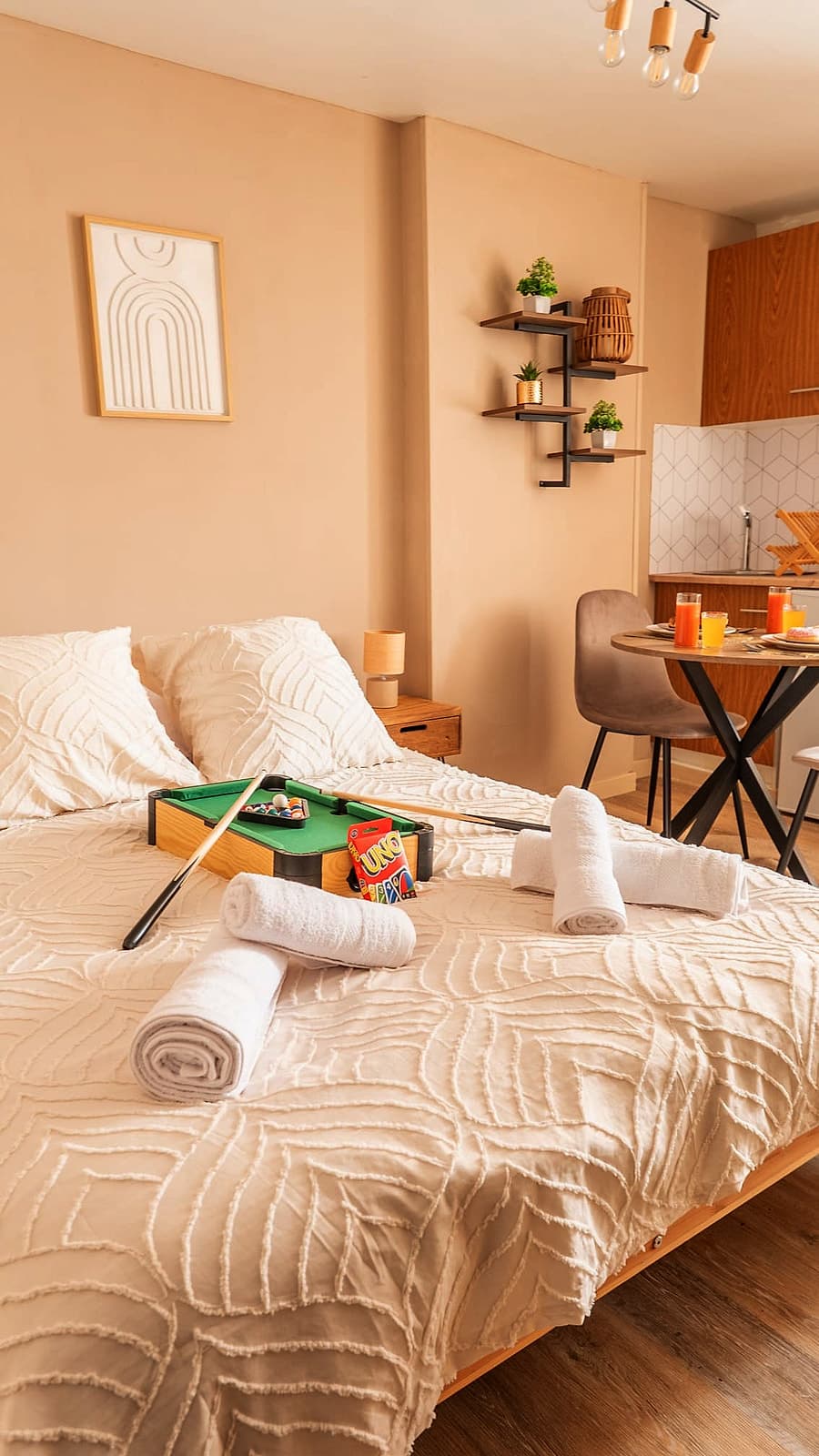
Guaranteed rent plan
Side by side
How we move forward
Fifteen minutes. We tell you straight away whether the arrangement works where you are.
We come and see the property, and we put a figure on the rent we can guarantee.
A written lease: permission to sublet and its price, the term, the inventory, maintenance commitments.
Full furnishing if the property is empty, topping up the equipment if it is already furnished, photo shoot, listings created, council declaration, registration number, published across our channels.
On a fixed date, written into the lease. Every month, with a short report on the property.
Frequently asked
Yes, under strict conditions. Article 8 of the law of 6 July 1989 forbids a tenant from subletting without the landlord's written consent, covering both the principle and the price. Without that written consent, the sublet is unlawful. The lease we offer was drafted by a lawyer and carries that consent in writing: the arrangement is entirely lawful, and nothing stops you having your own adviser read it before signing — we actively recommend it.Article 8, law no. 89-462 of 6 July 1989
No. That same article 8 requires the sublet price per square metre of habitable area not to exceed the head rent. It is the model's central constraint: the operator's margin comes from the number of nights let, never from an inflated sublet rent.
Termination of the lease and eviction. More importantly, the Cour de cassation holds that sublet rents collected without permission are civil fruits belonging to the landlord, who can demand them back in full. That's why we always require written consent before operating.Cass. 3e civ., 12 September 2019, no. 18-20.727
The winter moratorium suspends every eviction measure from 1 November to 31 March, even after a final court decision. It protects the occupant of a residential home. Under professional subletting, the occupant is there for a short stay under a stay agreement, and the owner receives rent from the tenant company regardless of occupancy.Article L. 412-6 of the French code of civil enforcement procedures
A company takes your property on a lease, with your written permission to sublet, pays you a fixed rent every month, then runs it as a short or medium-term let at its own risk. You receive guaranteed income with no management, no void periods and no occupancy risk.
Yes. An owner may grant a lease to a legal entity. The applicable regime depends on the agreed use: a general lease under the Civil Code, a professional lease or a commercial lease. The contract must expressly state the permission to sublet and its price.
The building's rules may restrict or prohibit furnished holiday letting, typically through an exclusive residential-use clause. A valid clause overrides the landlord's permission, so we check this before any signature, never after.
Yes, and it is now universal. The law of 19 November 2024, known as the loi Le Meur, introduced a declaration requiring registration through a national online service, applicable in every French council since 20 May 2026. The number must appear on every published listing.Law no. 2024-1039 of 19 November 2024; art. L.324-1-1 Tourism Code
Failing to declare exposes you to an administrative fine of up to €10,000. A declaration containing false information is punishable by up to €20,000. It is currently the single biggest financial risk facing an owner letting without support.
It falls under industrial and commercial profits and is declared on form 2042 C PRO: boxes 5NH and 5OH for an unclassified holiday let under the simplified regime, 5NG and 5OG for a classified one. We provide the annual summary you need.impots.gouv.fr
For an unclassified let, the flat-rate deduction is 30% with a €15,000 revenue threshold — down from 50% and €77,700. For an officially classified let it remains 50% with a €77,700 threshold. Getting your property classified has therefore become decisive again.impots.gouv.fr, 2025 income declared in 2026
Industrial and commercial profits. French tax doctrine states that income from furnished letting falls under BIC whether the landlord is the owner or the head tenant. It is subletting of unfurnished premises that falls under non-commercial profits.BOFiP, BOI-BIC-CHAMP-40-20
Next step
A costed study, specific to your property and your local council. You get it within 48 working hours. Do whatever you like with it, including nothing.
Free. No commitment. No automated follow-ups.