Airbnb publicly documents the factors that influence how a listing ranks: quality, popularity, price, location, availability, flexibility, responsiveness, cancellation history and Superhost status. Everything outside that list is hypothesis. The twelve levers below are sorted by what can actually be demonstrated.
How Airbnb ranking works
The engine does not rank listings in the abstract: it ranks listings for a given search, with dates, a guest count and filters. The same listing can be first on one query and invisible on another the same day. Asking about « your position » without specifying the search is therefore meaningless, and it is the leading source of false conclusions.
- Quality: photos, ratings, reviews, accuracy of the description.
- Popularity: wishlist saves, booking frequency, messages received.
- Price: competitiveness against comparable homes for the same dates.
- Location: proximity to the points of interest in the search.
- Availability: more open dates, more chances to appear.
- Flexibility: willingness to accept varied stay lengths.
- Responsiveness: speed of reply to enquiries.
- Cancellation history: a low cancellation rate helps.
- Superhost status: the status itself counts among the factors.
Two useful points from the same documentation: Airbnb deliberately introduces diversity into results, varying hosts, features and price ranges, and a new listing appears in search within twenty-four hours. The first explains why your position moves without anything changing on your side; the second, why relisting to « restart » a listing achieves nothing.
Family 1 — the listing itself
Lever 1 — the cover photo
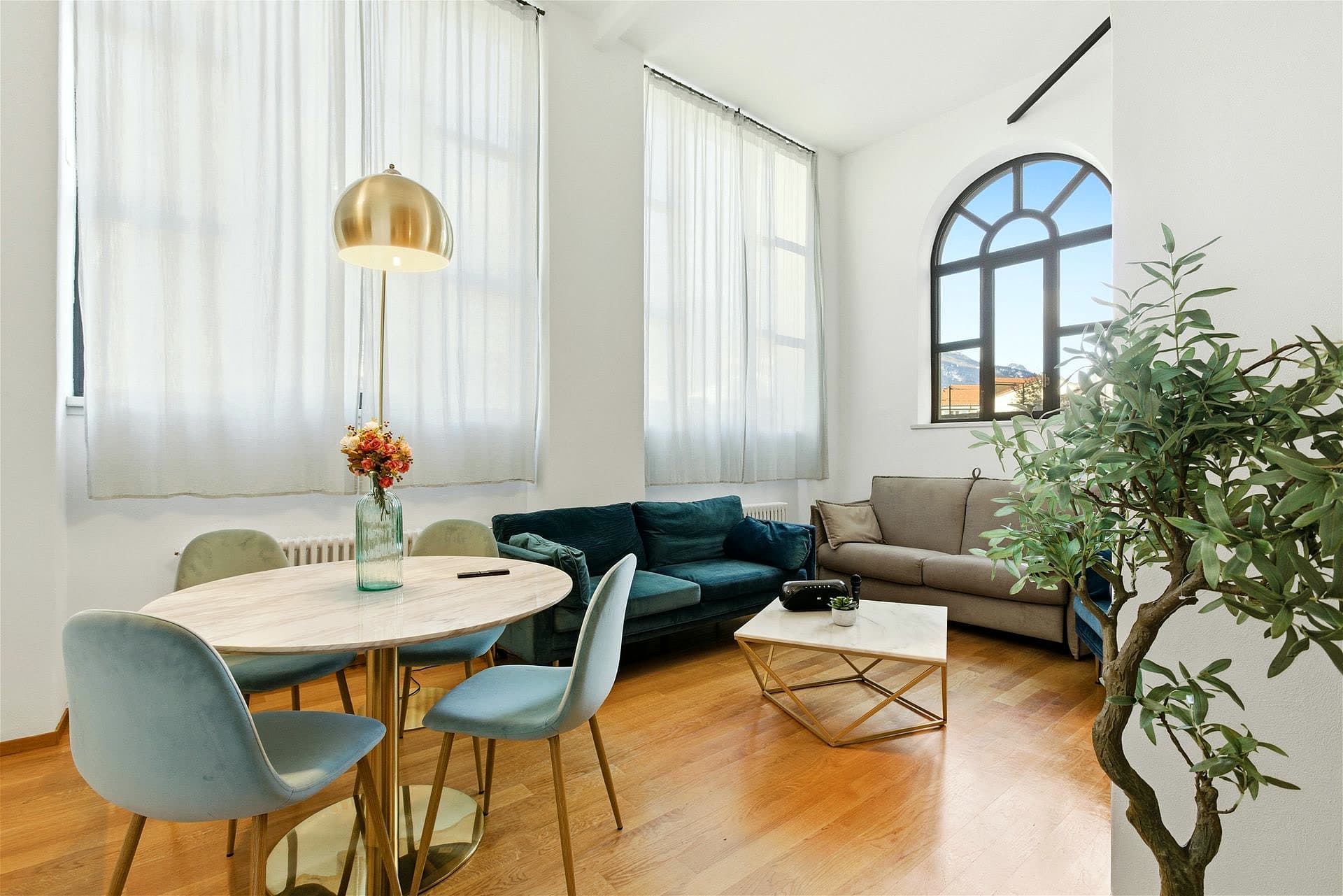
Visual quality is among the documented factors. The cover photo is the only element working before the guest reads a word: it decides the click, and therefore the traffic on which every other lever will act. A bright living space, framed wide, shot in daylight, beats a façade or a bedroom in almost every case. Evidence: documented for quality, mechanical for the effect on clicks.
Lever 2 — the title
Titles are truncated on mobile: only the first words are guaranteed to show. Put there what differentiates and what reassures — the rarest feature of the property, not an adjective. « Studio, lake-view balcony, 5 min from tram » works; « Magnificent flat ideally located » says nothing another listing does not. Evidence: folklore for wording recipes, mechanical for mobile truncation, which takes three seconds to verify on a phone.
Lever 3 — the description and the first screen
The description collapses after a few lines. What matters happens before the « read more » button: who the property suits, what sets it apart, and the answer to your market's main objection — noise, parking, no lift, distance to the station. An objection handled in the listing is a cancellation avoided and one mediocre review fewer.
Lever 4 — declared amenities
This is the highest-return and most neglected lever, because it is not glamorous. Amenities feed the search filters: an unticked washing machine makes the listing invisible to everyone filtering on it, whatever else is true. Going through the full list once a year, ticking everything that genuinely exists, takes twenty minutes. Evidence: mechanical — a filter excludes; this is not a question of algorithm.
Lever 5 — booking rules
Minimum stay, advance notice, booking window: these settings determine which searches can see you at all. A three-night minimum removes you from every two-night search, which is fine as a deliberate choice and a mistake if nobody has reopened it in two years. Airbnb documents flexibility among its factors. Evidence: documented.
Family 2 — host behaviour
Lever 6 — response time
Responsiveness is a documented factor, and it is also a quantified Superhost criterion, requiring a response rate of at least 90% to new messages. It is the easiest lever to hold under delegated management and the hardest to hold alone, because it cannot be recovered: an enquiry answered the next day has already booked elsewhere. Evidence: documented.
Lever 7 — host cancellations
Cancellation history appears explicitly among the ranking factors, and the Superhost threshold is set below 1%. A single cancellation on a small booking volume is enough to lose the status for the year. The practical consequence is simple: a calendar synchronised across platforms beats an optimistic one. Evidence: documented.
Lever 8 — overall rating and Superhost status
Superhost status is itself a ranking factor, and its criteria are published and quantified. They are assessed over the last twelve months and reviewed quarterly, which means a bad quarter is recoverable, but slowly.
| Superhost criterion | Official threshold |
|---|---|
| Completed stays | 10 stays, or 3 stays totalling at least 100 nights |
| Response rate | 90% minimum |
| Cancellation rate | Under 1%, excluding extenuating circumstances |
| Overall rating | 4.8 out of 5 minimum |
| Assessment period | Rolling 12 months, reviewed each quarter |
Lever 9 — Instant Book
It sits under responsiveness and flexibility, both documented factors: a listing bookable without approval is by construction as responsive as possible. The cost is real — you lose manual screening of guests — and is offset by setting booking requirements upfront rather than sorting case by case. Evidence: documented for responsiveness, folklore for the specific ranking gains sometimes quoted.
Family 3 — revenue management
Lever 10 — relative price
Airbnb documents price as a factor, assessed against comparable homes for the same dates. The important word is « comparable »: your price is not judged in the abstract but against a set you do not choose. Hence the only method that holds — compare against genuinely equivalent properties on capacity, amenities and location, not against the cheapest listing in the district. Evidence: documented.
Lever 11 — availability and calendar freshness
More open dates, more chances to appear: documented, and arithmetic. A calendar closed six months ahead ranks on no search covering those dates. Conversely, the belief that « touching your calendar daily » lifts a listing rests on no source at all. Evidence: documented for availability, folklore for daily fiddling.
Lever 12 — stay lengths and discounts
Weekly and monthly discounts do not change ranking, they change the stay mix — and the stay mix changes net result far faster than it changes revenue. Three seven-night stays produce almost the same revenue as seven three-night stays, with four fewer cleans and four fewer linen sets. Evidence: mechanical, and verifiable on your own statements.
Summary: impact and evidence level
| Lever | Estimated impact | Evidence level |
|---|---|---|
| Cover photo | High | Documented (quality) + mechanical (clicks) |
| Title | Medium | Mechanical (truncation) + folklore (wording) |
| Description, first screen | Medium | Mechanical |
| Declared amenities | High | Mechanical (search filters) |
| Booking rules | High | Documented (flexibility) |
| Response time | High | Documented |
| Host cancellations | High | Documented |
| Rating and Superhost status | High | Documented, published thresholds |
| Instant Book | Medium | Documented (responsiveness) |
| Relative price | High | Documented |
| Calendar availability | High | Documented |
| Stay lengths and discounts | Medium on revenue, high on net | Mechanical |
What occupancy rate should you aim for?
There is no general answer, and saying so beats inventing a figure. An occupancy rate is only comparable at an equal number of nights offered, on the same seasonality and in the same city. The averages published by market aggregators are reconstructed from public calendars, where a night blocked by the host is indistinguishable from a night sold: they structurally overstate.
Six mistakes that cap a listing
- 01Amenities that exist but are not ticked. The listing is excluded from the matching filters: that is not poor ranking, it is plain absence from the results.
- 02A minimum stay set once and never revisited. It removes the listing from entire searches, often without anyone remembering it is there.
- 03A calendar not synchronised across platforms. Sooner or later it produces a host cancellation, which hits both a documented ranking factor and Superhost status.
- 04A price aligned on the cheapest listing nearby rather than on genuinely comparable homes. You destroy margin without gaining position, since the comparison is not made against that set.
- 05Wide-angle photos promising more than the property delivers. They lift clicks and depress ratings — trading an immediate gain for a lasting loss.
- 06No replies to reviews, negative ones included. The review is read by the next guests; a factual, non-defensive reply defuses the objection for every future reader.
The 30-minute audit checklist
- 01Five minutes — Run a real search on your city with real dates, from a mobile in private browsing. Note where you appear, and which listings sit ahead of you.
- 02Five minutes — Open the three listings ranked above you. Record facts only: displayed price, rating, review count, ticked amenities, minimum stay.
- 03Five minutes — Go through the entire amenities list and tick everything that genuinely exists. This is the one step that often produces a visible effect within days.
- 04Five minutes — Check your booking settings: minimum stay, advance notice, booking window, calendar synchronisation.
- 05Five minutes — Look at your cover photo as a thumbnail, on a phone screen, without zooming. If it does not read at that size, it is not working.
- 06Five minutes — Reread your last three mediocre reviews and note the recurring objection. Address it in the description before addressing it in the property, then schedule the real fix.
Frequently asked questions
Airbnb documents quality, popularity, price, location, availability, flexibility, responsiveness, cancellation history and Superhost status. Ranking also depends on the search performed: dates, guest numbers and filters all change the order of results.
Nothing documents that, and doing so loses your reviews, your seniority and your rating history — three things that do officially count. A new listing appears in search within twenty-four hours, which is not the same as a ranking advantage.
Airbnb publishes no optimal number. What is documented is visual quality as a factor. In practice, covering every room and every amenity you advertise beats hitting an arbitrary total.
Yes, Airbnb lists it among its factors. The criteria are quantified: 10 stays or 3 stays of 100 nights, a 90% response rate, under 1% cancellations, a minimum 4.8 rating, assessed over a rolling twelve months each quarter.
Price is a documented factor, but it is judged against comparable homes for the same dates. Cutting below your true comparables destroys margin without guaranteeing position, and it lowers revenue per available night.
Sources cited in this article
- Airbnb — Comment fonctionne le classement des annonces dans la recherche
- Airbnb — Critères du statut de Superhost
- Airbnb — Réservation instantanée
- Airbnb — Calcul de votre versement
- Déclarer en mairie un meublé de tourisme — service-public.gouv.fr
This article is reviewed and updated whenever the rules change.
The regulatory and tax information published on this site is provided for general guidance, with its source and date. It does not constitute personalised legal, tax or accounting advice.